
Wildlife of Tipeshwar Sanctuary: Beyond Tigers in India's Best Hidden Safari
The Wildlife of Tipeshwar: Most Underrated Biodiversity Hotspot
Unlike the crowded landscapes of larger tiger reserves, Tipeshwar Wildlife Sanctuary offers something far more intimate, a compact ecosystem where predator, prey, and lesser-known species coexist in unusually high visibility. Tipeshwar Wildlife Sanctuary is not a place that announces itself loudly. Its magic lies in accumulation, in the way habitats shift gently into one another, in how animals reveal themselves slowly, and in how time spent here sharpens the senses. This is a landscape that rewards patience, curiosity, and quiet observation.
Spread across just ~148 sq km, Tipeshwar compresses what many parks struggle to deliver: diverse wildlife encounters within short safari durations.
The Landscape of Tipeshwar
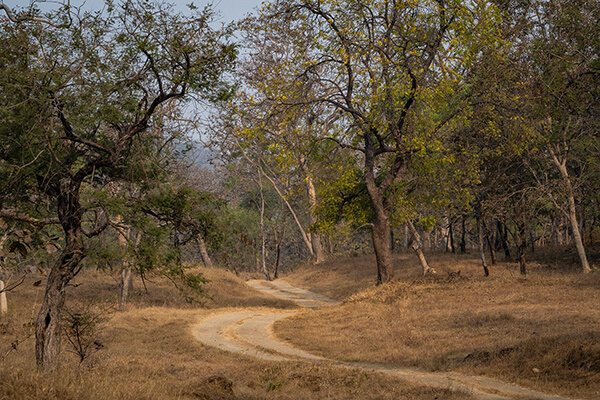
What gives Tipeshwar its ecological depth is the variety of landscapes compressed into a relatively intimate geography. Teakwood forests dominate large tracts, their tall, straight trunks lending the forest a cathedral-like stillness. These transition seamlessly into dense bamboo thickets, which provide critical cover for birds, small mammals, and breeding predators.
Open grasslands punctuate the forest, especially around Kodori, drawing grazers and the predators that follow them. Beyond this lie rolling, barren hills, stark and beautiful, offering panoramic views and thermal lift for raptors. A large perennial waterbody, locally known as the Talav,anchors the sanctuary, becoming a magnet for wildlife across seasons. Scattered through this terrain stand old tamarind trees, silent markers of villages relocated decades ago, now woven back into the wild fabric of Tipeshwar.
It is this layered landscape that allows such diverse wildlife to coexist with remarkable balance.
Wildlife & Forest management in Tipeshwar
Tipeshwar’s health is no accident. The sanctuary is managed with an emphasis on long-term ecological resilience rather than spectacle. Regularly maintained fire lines reduce the risk of uncontrolled forest fires. Trenches and contour works aid soil conservation and groundwater recharge, particularly vital in the drier months.
Seasonal ponds are replenished using solar-powered pumps, ensuring water availability without noise or disruption. Grassland management encourages native forage species, strengthening the prey base. Along the forest fringe, proactive compensation for livestock losses has helped reduce conflict and foster coexistence with local communities, an often-overlooked cornerstone of conservation success.
The result is a forest that feels settled, stable, and unhurried.
Plan your Dream Safari Travel
Get in touch today and receive a complimentary consultation.
Tigers of Tipeshwar
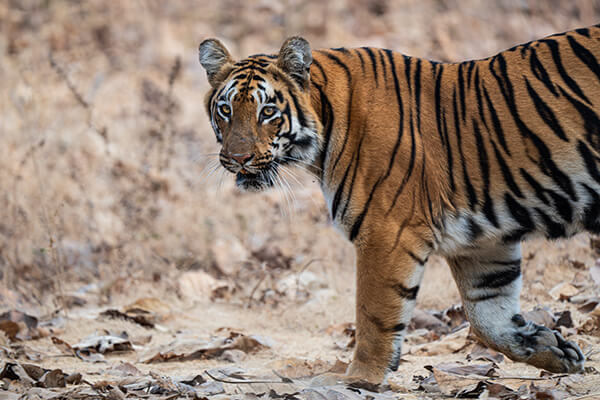
Tipeshwar’s tigers are known not just for visibility, but for behavioural richness. Early mornings and late evenings may reveal a tiger methodically marking territory, pausing to rake bark with its claws or spray-mark along forest roads. At times, cubs are seen tumbling clumsily behind a tigress, moments of play unfolding without interruption.
Long, uninterrupted walks, where a tiger moves confidently along a track for kilometres, are not uncommon here. Head-on encounters feel grounded rather than dramatic, the animal unperturbed by distant vehicles. Skilled guides often draw attention to subtle signs: the faint scent of a recent kill, fresh pugmarks, or deep claw marks on trees that speak of presence long after the tiger has moved on.
Tipeshwar’s tigers are not defined by a single temperament. The sanctuary’s low tourism pressure and stable territories allow individual personalities to emerge, subtle, varied, and deeply instructive for those who watch closely.
Young males, newly independent and testing their confidence, are occasionally seen mock-charging safari vehicles. These brief displays are rarely aggressive; instead, they reflect curiosity and youthful assertion, a reminder of the learning curve that defines a tiger’s early adulthood.
In contrast, some resident females, particularly those with older cubs display remarkable composure. It is not uncommon to observe a bold tigress moving through her territory with cubs in tow, paying little attention to passing vehicles, her focus fixed entirely on guiding and schooling her young.
Equally present are the shyer individuals, especially females raising very young cubs. These tigers favour cover, crossing tracks quickly or melting into bamboo thickets with practiced ease. Their discretion is an encouraging sign of natural maternal behaviour, supported by a landscape that allows privacy rather than pressure.
Water plays a quiet but important role in Tipeshwar’s tiger ecology. During warmer months, tigers are often seen resting in the shallows of the Talav or cooling off in forest ponds, their massive forms half-submerged, eyes half-closed, entirely unbothered. These moments, unrushed and intimate, capture the sanctuary at its best.
Whether confident or cautious, playful or purposeful, Tipeshwar’s tigers are allowed to be themselves. Their behaviour is not shaped by crowd dynamics or competition for space, but by the rhythms of the forest.
In Tipeshwar, the tiger is not a spectacle, it is simply a presence, moving through a landscape that still gives it room to breathe.
Beyond Tigers: The real wildlife of Tipeshwar
Tipeshwar is definitely known for its growing tiger population. But what truly sets it apart is what most overlook:
1. The Underrated Predator Guild
- Leopards (often overlapping tiger territory)
- Dholes (Indian wild dogs)
- Striped hyenas
This multi-predator presence creates dynamic ecological interactions.
2. Rare & Overlooked Mammals
Tipeshwar quietly hosts species that are harder to spot in mainstream parks and often ignored in safari scenes.
Including:
- Rusty-spotted cat (world’s smallest wild cat)
- Honey badger
- Indian palm civet
- Four-horned antelope (chousingha)
3. Grassland Specialists
Unlike dense forests like Kanha or Bandhavgarh, Tipeshwar supports:
- Nilgai (blue bull)
- Blackbuck
- Chinkara
Wildlife encounters in Tipeshwar rarely feel staged. A troop of Hanuman langurs, often with infants clinging to their bellies, moves deliberately through the canopy. Below them, nilgai and chital feed, alert but unhurried. The relationship is symbiotic-langurs drop fruits and leaves, while the ungulates’ heightened vigilance offers early warning of danger.
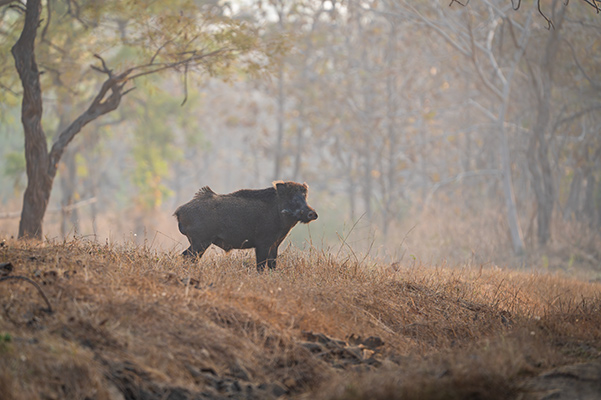
Large wild boars are common, their bodies powerful and bristled, tusks catching the light as they move cautiously through open patches. Skittish yet imposing, they melt into cover with surprising grace when alarmed.
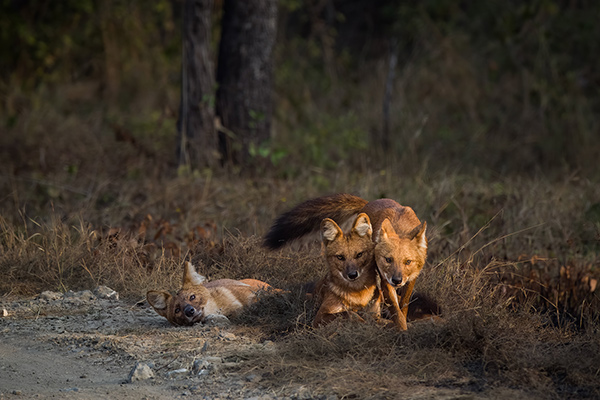
Indian wild dogs are often encountered during their morning ritual walks, a closely bonded group moving with purpose. There is play, scent marking, gentle jostling, and constant communication. Even at rest, their alertness suggests readiness, the hunt never far from thought.
Birds of Tipeshwar
Tipeshwar is quietly rich in birdlife. Over time, well over a hundred species have been recorded, with the Talav alone hosting dozens during peak seasons. Early mornings here unfold to a layered soundscape rather than silence.
Commonly encountered species include:
- Crested serpent eagle
- Changeable hawk-eagle
- White-eyed buzzard
- Long-legged buzzard
- Shikra
- Indian peafowl
- Indian roller
- Grey francolin
- Asian paradise flycatcher
- Black drongo
- White-breasted kingfisher
- Green bee-eater
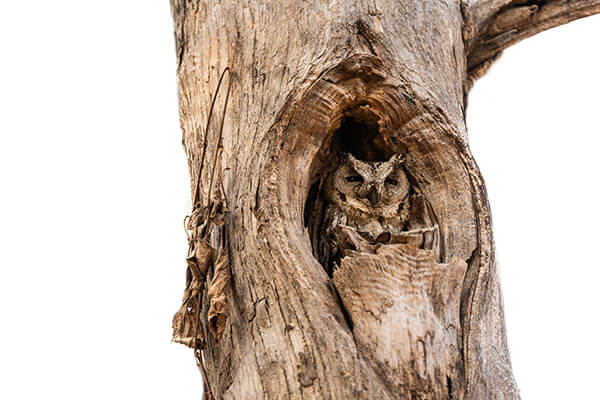
The bamboo thickets are particularly alive after dusk, harbouring Indian spotted owls, scops owls, and other nocturnal specialists. Experienced guides often point out marked trees where owls and parakeets return year after year. Three parakeet species, the Alexandrine, rose-ringed, and plum-headed are frequently seen, their calls carrying far across the forest.
Buzzards deserve special mention. The white-eyed buzzard, in particular, is a regular presence, often perched patiently on exposed branches, surveying the grasslands below.
Why Tipeshwar is a Dream Destination for Wildlife Photographers
Photographers are increasingly drawn to smaller parks in India to photographs wildlife because the uncrowded safari roads are perfect to approach wildlife without disturbing them.
For wildlife photographers, Tipeshwar Wildlife Sanctuary feels like a rare creative playground where every element aligns in your favor. The open dry deciduous habitat allows for clean, unobstructed compositions, while soft golden light during morning and evening safaris adds depth and drama to every frame. Unlike crowded reserves, fewer vehicles mean uninterrupted sightings and the freedom to experiment with angles, patience, and storytelling. Beyond tigers, the diversity of subjects, from elusive predators to rich birdlife, ensures a varied portfolio, making Tipeshwar not just a place to capture wildlife, but a destination where truly distinctive images are created.
An ethical way of seeing Wildlife of Tipeshwar
What ultimately defines wildlife viewing in Tipeshwar is low pressure. Fewer vehicles, patient guiding, and a landscape that does not funnel animals into predictable corners allow encounters to unfold naturally. Animals behave as they would without an audience and that honesty is what stays with visitors long after the safari ends.
Tipeshwar does not promise constant drama. Instead, it offers something more enduring: a forest that feels whole, animals that feel unhurried, and stories that reveal themselves only to those willing to slow down.
At Tipeshwar, ethical wildlife tourism is not a slogan, it is a daily discipline. Guides are consciously nudged to avoid crowding animals, to maintain respectful distances, and to always allow wildlife clear space to move away if it chooses. There is no rushing for sightings, no aggressive positioning of vehicles, and no compromise on safety, either for animals or for guests. A sighting here is allowed to unfold at the animal’s pace, even if that means watching it disappear quietly back into cover.
Equally important is the sanctuary’s investment in people. Young women from nearby villages are being trained as the next generation of naturalists and field guides, mentored closely under the watchful eyes of experienced professionals. This gradual, skill-led approach not only builds local livelihoods but also ensures that knowledge, ethics, and respect for the forest are passed on with care. In Tipeshwar, conservation is understood as a shared responsibility, rooted as much in community as it is in wilderness.
In a world of increasingly crowded safari destinations, Tipeshwar stands apart, not by trying to impress, but by simply being itself.