Conservation & Sustainable Eco Tourism
Trusan Sugut: Conservation and Sustainable Wildlife Tourism in Borneo
How a former logging concession in northern Sabah became one of Borneo's quietest wildlife forests, and why visiting it, carefully, helps keep it that way
Most conversations about wildlife tourism in Borneo end up in the same few places, and with good reason: the Kinabatangan, Danum Valley and the orangutan centres near Sandakan are extraordinary. They are also busy. For travellers who want to see wild Borneo without the crowds, and who want their visit to do some good for the forest rather than simply take from it, there is a quieter answer in the north of Sabah.
Trusan Sugut Forest Reserve is a conservation success story still being written. Logged for timber until 2014, it was then reclassified as a Class I Protection Forest, the highest level of forest protection in Sabah, and has spent the years since being restored, patrolled and monitored. Only recently has it opened to small numbers of visitors, through guided programmes designed to fit inside the conservation plan rather than compete with it.
This guide explains how that recovery works: the restoration, the communities and rangers who protect the reserve, the research behind it, and what sustainable, low impact wildlife tourism actually looks like on the ground. It is also our honest view of why Trusan Sugut matters, and how to visit responsibly.
Protected Forest
Class I Protection Forest
Mammal Species
Bird Species
From Timber Concession to Class I Protection Forest
Trusan Sugut lies about 75 kilometres northwest of Sandakan, in the Beluran district of northeastern Sabah, between the Sugut and Paitan rivers. It is true lowland, its highest point under 200 metres above sea level, and its original forest was a rich mosaic: mangrove along the coast, freshwater swamp forest, mixed dipterocarp forest, heath like kerangas forest and a thin strand of beach forest.
For decades the reserve was gazetted as a Class II commercial forest, managed for timber. Apart from the mangroves, almost all of it was logged or disturbed. In 2010 the Sabah Forestry Department set up the Sugut Sustainable Forest Management Project to change its direction, and on 24 December 2014 the reserve was reclassified as a Class I Protection Forest. In Sabah, Class I forests are kept for the protection of watersheds, soil and wildlife, and no timber harvesting is permitted.
That change in status was the turning point. What followed was not a fence around a finished forest but a long programme of restoration, protection and monitoring, run by the Beluran District Forestry Office with partners including WWF Malaysia, Universiti Malaysia Sabah, neighbouring estates and the villages around the reserve. In 2017 that work earned Trusan Sugut a Forest Stewardship Council certificate as a well managed forest.
Part of the Sugut Conservation Area
Trusan Sugut does not stand alone. It is the core of the larger Sugut Conservation Area, which links it with the Sugut Wildlife Corridor Forest Reserve, a chain of mangrove reserves along the Sugut, Paitan, Labuk and Bonggaya river mouths, and the conservation zone of the neighbouring Sugut Forest Reserve.
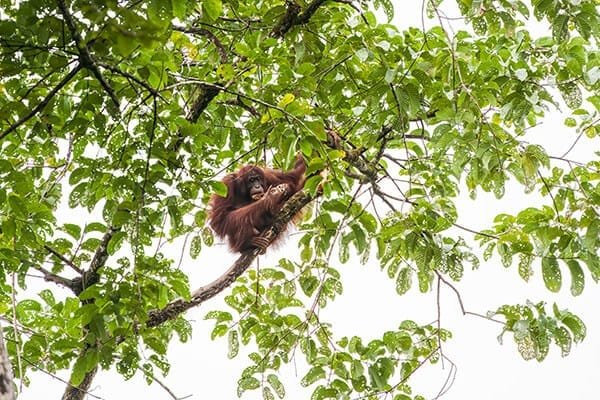
That connectivity is the point. Wildlife in Borneo needs room to move, between coast and interior, between fruiting seasons, between populations. By joining coastal mangroves to inland forest, the Sugut landscape gives Bornean orangutans, banteng, hornbills, proboscis monkeys and other rainforest species a continuous habitat in a part of Sabah where much of the lowland has been converted to plantation.

Replanting a Forest for Its Wildlife
Restoration in Trusan Sugut is deliberately practical. Rather than planting single timber species in rows, the Forestry Department has focused on enrichment planting: native dipterocarps and, above all, local fruit trees such as wild mango and durian, planted into degraded and open areas of the reserve. The aim is not only to bring back canopy but to bring back food and shelter, so that the forest can feed the orangutans, hornbills, bearded pigs and other animals that depend on it.
Planting began in 2014 and continued through the following years compartment by compartment, with roughly 160 hectares of enrichment planting completed by 2017 and more than 170 hectares recorded by 2019. Much of this work has been carried out with the active involvement of people from the villages around the reserve, and planted areas are maintained and checked for survival rather than planted and left.
Fruit Trees, Not Timber
Native fruit species and dipterocarps planted into logged areas, chosen to provide food and shelter for wildlife as well as canopy cover.
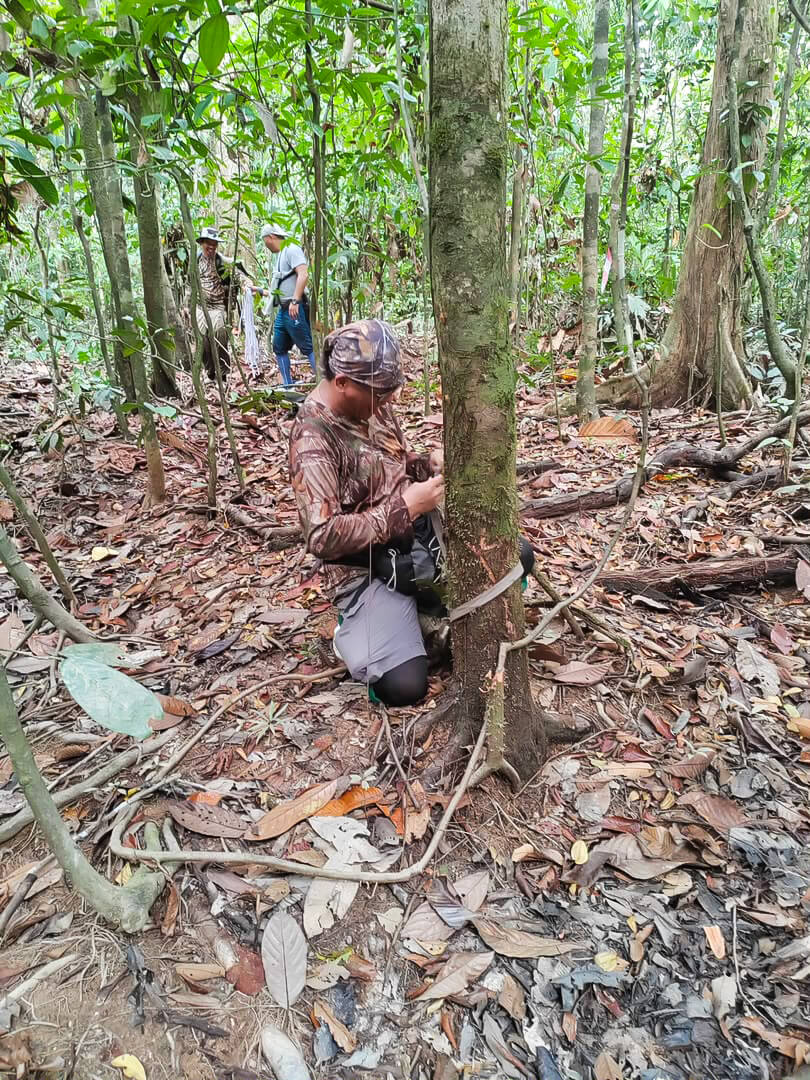
Camera Traps and Field Surveys
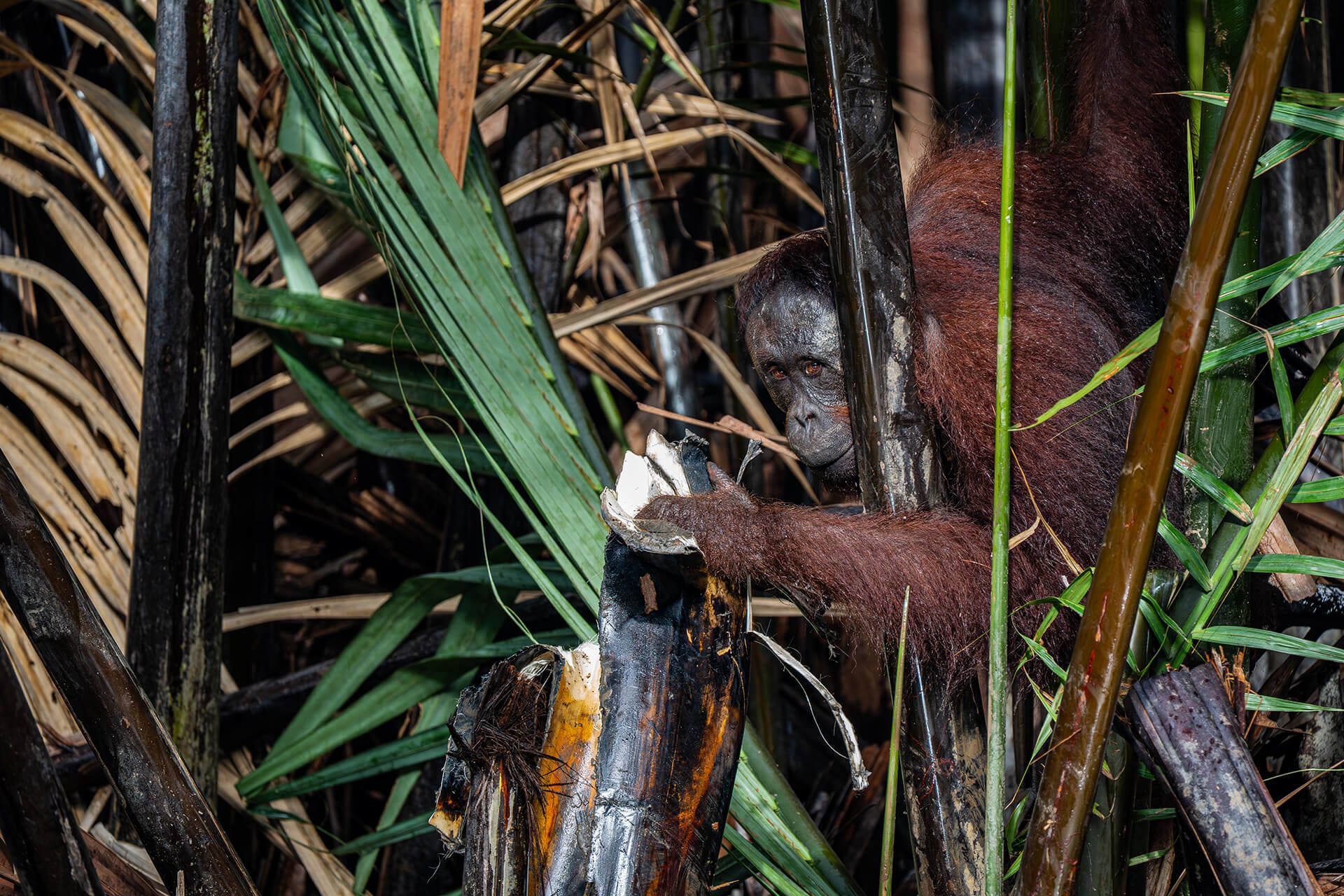
WWF Malaysia surveys using camera traps have confirmed orangutan, banteng, sambar deer, sun bear, rhinoceros hornbill and many other species across the reserve.
A Forest That Is Watched, Counted and Studied
Conservation only works if you know what you are protecting. Scientific surveys in the Sugut Conservation Area, led largely by WWF Malaysia, have relied on camera traps set at strategic points across the reserve, and the Forestry Department records wildlife sightings systematically year by year. Surveys have documented 168 mammal species, 335 bird species, 103 reptiles, 57 amphibians and 365 butterflies in a reserve smaller than many of Sabah's better known forests.
Camera traps have recorded Bornean orangutan, banteng, sambar deer, Bornean yellow muntjac, sun bear, slow loris, bearded pig, proboscis monkey, both long tailed and pig tailed macaques, and the crested fireback pheasant. Permanent sampling plots track how the vegetation itself is recovering.
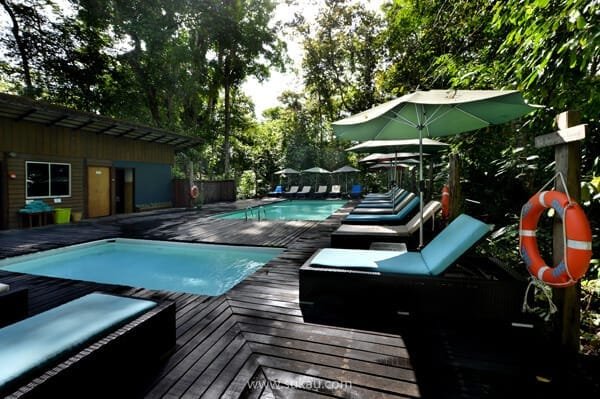
Accommodation inside the reserve, at the Frederick Kugan Base Camp, began as a field station for exactly this kind of work: research, biodiversity monitoring and environmental education. Visitors now share it, which means guests stay in a working conservation base rather than a resort built beside one.
The Communities Who Guard the Forest
No forest in Borneo is protected by rules alone. In 2014 the project held a community consultation that led to a standing Community Committee, with representatives from the four villages bordering the reserve: Kampung Terusan Sugut, Kanoigan, Keliaga and Buring. The committee meets with the Forestry Department to resolve issues that affect both the villages and the reserve, and it has given local people a direct voice in how the forest is managed.
The partnership has created work as well as dialogue. Young people from these villages have been employed in restoration and silviculture, and in 2016 nine villagers were appointed Honorary Forest Rangers under Sabah's Forest Enactment. When people who live beside a forest earn a living from protecting it, the forest has its strongest possible defence.
Protection on the Ground
The Sabah Forestry Department is responsible for guarding the Sugut Conservation Area against encroachment, illegal hunting, theft of mangrove produce and forest fire. Armed forest officers are stationed in the project area, forest checking stations and jetties control access, and patrols run by land, by sea and from the air. The department also works with the Royal Malaysian Police on joint operations along the coast.
This is one reason why independent, walk in visits are not permitted. Every visitor enters through a managed programme, with a licensed guide, along routes the reserve chooses. For the guest, that means a safari in a forest where the main human presence is the people protecting it.
How Small Scale Tourism Supports Conservation in Sabah
Wildlife tourism can harm a forest as easily as it can help one. The difference lies almost entirely in scale and design. At Trusan Sugut, tourism has been introduced late, into a reserve that already had a management plan, protection and monitoring in place, and it has been shaped to fit that plan.
Done this way, tourism contributes in four ways. It creates value from a standing forest, showing that an intact, recovering reserve can earn more over time than the timber once taken from it. It creates local jobs, in guiding, driving, cooking and camp operations. It adds eyes in the forest, as every guided drive is another set of observations along the tracks. And it builds a constituency of visitors who have seen the reserve for themselves and care what happens to it next.
Equally important is what sustainable tourism here does not do. There is no feeding of wildlife, no habituation for photography, no new hotel inside the forest and no unrestricted access. The number of guests the base camp can hold is small, and that limit is part of the design, not a temporary shortcoming.
Borneo Without the Crowds: What a Trusan Sugut Visit Looks Like
How a conservation led visit here differs from a stay on Borneo's busier wildlife circuits.
| Busier Borneo Circuits | Trusan Sugut | |
|---|---|---|
| Visitor numbers | Many lodges and boats on the same stretch of river in peak season | A single base camp with a handful of rooms inside the reserve |
| Access | Open to independent visitors and day trips | Guided programmes only; no walk in or independent visits |
| Management | Varies by site and operator | Run within a Sabah Forestry Department conservation plan |
| How you explore | Boat cruises and trails shared with other groups | Guided 4WD drives, limited trail walks and supervised night drives |
| Conservation link | Often indirect | Direct: tree planting, local employment and a working research base |
| Best for | First time visitors and guaranteed classic sightings | Experienced travellers seeking solitude and a meaningful visit |
How Guests Can Contribute
Plant a tree
Guests can join tree planting activities that support the reserve's restoration programme, planting native seedlings into areas still recovering from logging. It is a small act, but it connects a visit directly to the forest's future.
Follow the guide, and the forest's rules
Stay with your guide, keep a respectful distance from wildlife, keep noise low, never feed animals and take every piece of litter back out. On night drives, spotlights are used briefly and carefully so animals are not dazzled or chased.
Share what you see
The camp keeps a wildlife log, and guides pass sightings back into the reserve's records. If you photograph something unusual, a clouded leopard on a night drive or an orangutan nest in a new area, show your guide. Visitor observations add to what the reserve knows.
Travel lightly
The base camp runs on a generator and has limited satellite internet. Pack light, bring reusable bottles and accept that the forest is not built around constant connection. That is part of its value.
How to Choose a Responsible Wildlife Tour in Borneo
Whether you visit Trusan Sugut or anywhere else in Sabah, a few questions will tell you a great deal about how a wildlife tour is run.
Is the wildlife truly wild?
Responsible tours never feed, bait or call in animals. Orangutans seen in the forest should be living freely, not drawn to a feeding platform for visitors.
How big are the groups?
Small, private groups disturb wildlife far less and give you a better experience. Ask how many guests share a vehicle or boat.
Who are the guides?
Licensed, local guides who know the forest and follow the reserve's rules are essential. They are also the people whose income makes conservation worthwhile locally.
Does the visit connect to conservation?
Look for reserves under formal protection and programmes that link tourism to restoration, research or community benefit, rather than tourism simply placed beside a forest.
Is the operator honest about sightings?
No one can guarantee wild animals. An operator who promises them is either baiting wildlife or overselling. Expect honest odds and a realistic plan.
Building a Sustainable Borneo Wildlife Itinerary
Trusan Sugut is a natural part of a longer, low impact journey through Sabah's protected forests.
Two to three nights at Trusan Sugut pair well with Deramakot, a sustainably managed forest celebrated for its night drives and all five Bornean wild cats, and with Danum Valley, one of the last great stands of primary lowland rainforest in Southeast Asia. Add the Kinabatangan for river wildlife or Tabin for its mud volcano and pygmy elephants, and you have a journey that sees the best of Borneo while spending most of its time far from the crowds.
If orangutans are your priority, our guide to the best places to see wild orangutans compares Trusan Sugut with the other reserves on real odds. For a wider view of everything we do in Sabah, see our Malaysian Borneo overview or the Borneo primate tour.
Why we send guests to Trusan Sugut
Trusan Sugut is not the easiest wildlife destination in Borneo, nor the most famous, and sightings here are less predictable than on the classic circuits. The base camp is comfortable rather than luxurious. We are open about all of this.
We recommend it because it offers something increasingly rare: a recovering Bornean rainforest, formally protected, guarded by the communities around it, and visited by very few people. For experienced travellers who want wild Borneo without the crowds, and who want their journey to support the forest they came to see, it is one of the most meaningful places in Sabah to spend a few days.
Frequently Asked Questions
What travellers ask us about conservation and sustainable tourism in Trusan Sugut.
Conservation
What is a Class I Protection Forest?
It is the category of forest reserve in Sabah kept for protecting watersheds, soil and the wider environment. Timber harvesting is not permitted, and Class I reserves count among the state's totally protected areas. Trusan Sugut was reclassified from a commercial Class II forest to Class I on 24 December 2014.
Who manages Trusan Sugut Forest Reserve?
The Sabah Forestry Department, through its Beluran District Forestry Office, with partners including WWF Malaysia, Universiti Malaysia Sabah, neighbouring estates and the four villages bordering the reserve.
How is the forest being restored?
Mainly through enrichment planting of native dipterocarps and local fruit trees in logged and degraded areas, with local communities involved in the work. The fruit trees are chosen to restore food and shelter for wildlife as well as canopy.
Does visiting actually help conservation?
When it is small scale and guided, yes. Tourism here runs inside the reserve's management plan, creates local jobs, adds observers in the forest and shows that a protected, recovering forest has lasting value. Guests can also join tree planting directly.
Visiting
Can I visit Trusan Sugut independently?
No. Walk in and independent visits are generally not permitted. All visits are arranged in advance, with guests staying at Frederick Kugan Base Camp and exploring with licensed guides.
Will I see orangutans?
The reserve holds a wild orangutan population, and sightings are possible on drives and walks, but they are less predictable than at Deramakot or the Kinabatangan. We recommend three nights to give the odds time to work.
Is Trusan Sugut crowded?
No. With a single small base camp inside the reserve and guided access only, it is one of the least visited wildlife destinations in Sabah. On most days you are unlikely to meet another group.
How do I get there?
From Sandakan, either by road to Beluran jetty and then about an hour by longboat along the Sugut River, or overland by 4WD via Paitan. See our Trusan Sugut safari guide for full details.
Safari Acacia designs private, conservation minded wildlife journeys across Sabah, for travellers who want wild Borneo without the crowds. Read our full Trusan Sugut Forest Reserve guide, compare the reserves in Deramakot, Danum, Kinabatangan or Tabin, or explore our Malaysian Borneo overview.