Tadoba
The Jewel of Vidarbha
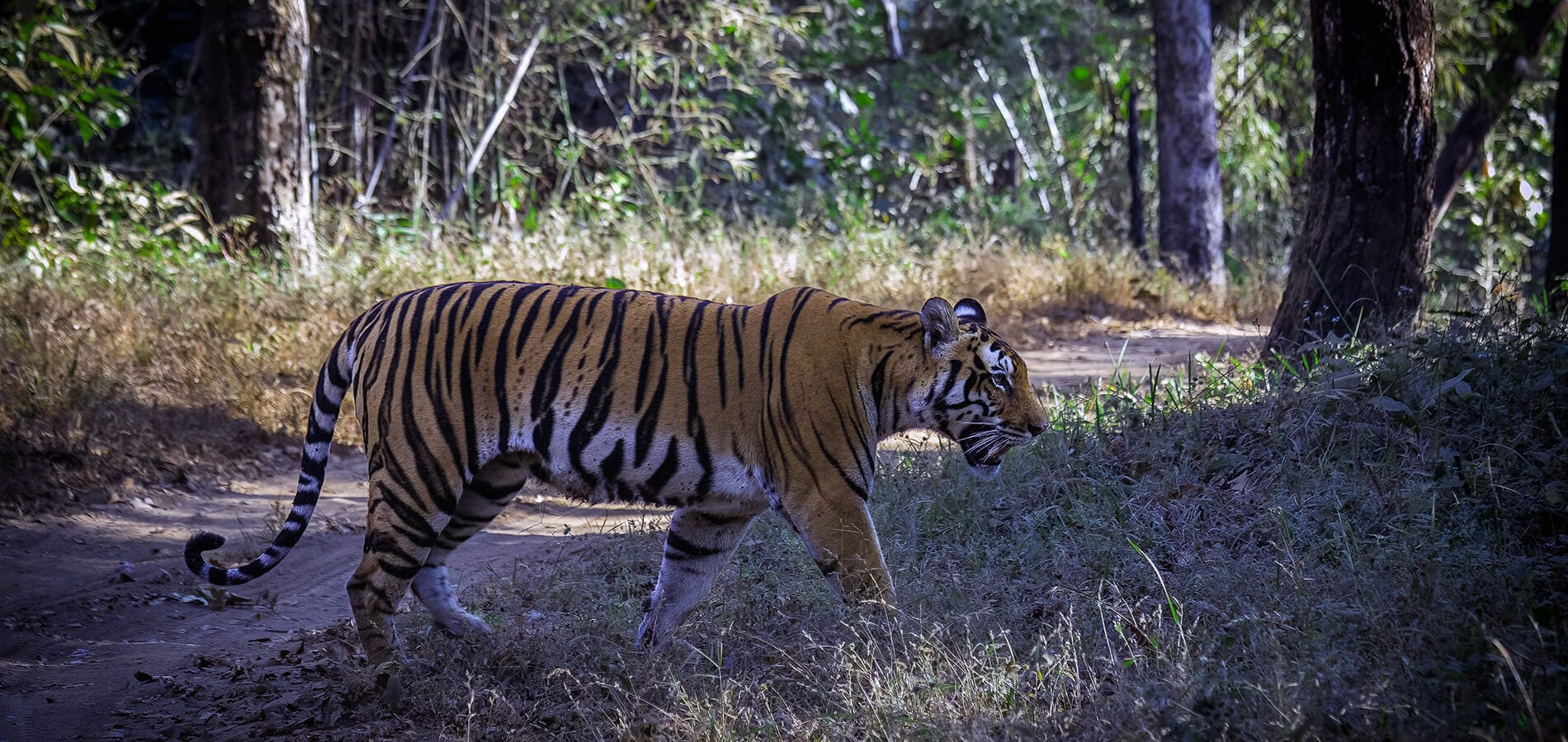
India's highest rate of successful tiger sightings per safari — not because tigers are most dense here, but because permanent lakes, open teak forest, and named, individually monitored animals create the conditions for extended encounters unavailable anywhere else in the country.
"There is a statistic on the Indian wildlife safari circuit that has been slow to reach mainstream awareness. Tadoba Andhari Tiger Reserve records the highest rate of successful tiger sightings per safari of any tiger reserve in India. The reason is structural — and once understood, it changes how you think about every other reserve."
Area
Core & Buffer
Species
Zones
Open Window
Maharashtra's oldest reserve — and India's most reliably productive tiger encounter
Tadoba Andhari Tiger Reserve is Maharashtra's oldest and largest tiger reserve, covering a total landscape of 1,727 square kilometres in the Chandrapur district of Vidarbha. The reserve comprises two distinct administrative units: Tadoba National Park (116.55 square kilometres), designated in 1955 as one of India's earliest national parks, and Andhari Wildlife Sanctuary (508.85 square kilometres), created in 1986 and amalgamated with the national park in 1995. The reserve came under Project Tiger in 1993–94.
What distinguishes Tadoba from every other Indian tiger reserve is not density but encounter geometry. The reserve's three permanent lakes — Tadoba Lake at the heart of the national park, Irai Lake on the core-buffer boundary, and Teliya Lake within the Mohurli zone — maintain full water levels through the hottest months of April, May, and June, when seasonal water bodies in Kanha, Bandhavgarh, and Pench reduce to muddy depressions. Wildlife drawn to permanent water behaves differently: it approaches openly, holds position, and remains in view long enough for a photographer to work through multiple focal lengths.
The forest structure reinforces this geometry. Tropical teak with a high canopy and open floor creates sightlines from vehicle to subject that no sal-forest reserve can match. The same tiger encounter that would be partially obscured in Kanha's understorey is fully visible at 50–100 metres in Tadoba's mature teak. It is this structural combination — open teak, permanent lake, named and monitored individuals — that produces the encounter rates and photographic quality for which Tadoba is specifically known among serious wildlife photographers.
An early morning safari in Tadoba
"More award-winning India tiger photographs originate from Tadoba than from any other single reserve. Open teak forest, perennial lakes, named individuals — this combination exists nowhere else simultaneously."
65 Mammals,
195+ Birds
Tadoba supports approximately 65 mammal species, 195 bird species, and 74 butterfly species. What distinguishes it is not the species list but the viewing quality — open teak sightlines, lake-edge settings, and low vehicle pressure combine to produce encounter conditions unavailable at any other Central Indian reserve.
Bengal Tiger
Panthera tigris tigris
India's highest tiger encounter success rate per safari. Named individuals — Maya, Matkasur, Choti Tara — tracked across multiple generations. Morning intelligence briefings at competent lodges include specific individual identity and predicted movement data.
Indian Leopard
Panthera pardus fusca
Strong population around rocky terrain and forest margins. Kolsa zone produces the most reliable leopard encounters — open teak sightlines provide visibility dramatically superior to the dense sal forests of Madhya Pradesh.
Sloth Bear
Melursus ursinus
Frequent and often prolonged encounters due to open terrain and rocky denning habitat. The Mahua flowering season in March and April is particularly productive for extended, unhurried sloth bear observation.
Gaur
Bos gaurus
Thriving population that regularly gathers around lake margins at dawn and dusk. The combination of massive bovine silhouettes against a lake surface at last light is one of Tadoba's defining visual spectacles.
Mugger Crocodile
Crocodylus palustris
Exceptional populations on all three permanent lakes. January and February basking groups at Tadoba Lake and Teliya Lake can reach twenty or more individuals simultaneously — a reptile spectacle rarely matched anywhere in India.
Striped Hyena
Hyaena hyaena
Encounters at dawn and dusk occur more frequently at Tadoba than at most other tiger reserves. An unexpected and genuinely exciting addition to any predator list — the open teak terrain and lake edges are productive habitat.
Dhole
Cuon alpinus
Healthy wild dog population across the reserve. Pack encounters in the open teak landscape are particularly dramatic — the sightlines that benefit tiger photography benefit dhole photography equally.
195+ Bird Species
Including Crested Serpent Eagle
Breeding populations of crested honey buzzard and changeable hawk-eagle. The Tadoba lake water bird assemblage — painted stork, purple heron, osprey — makes the lake circuit a productive standalone birding session.
Three core zones, one defining lake landscape
Zone selection at Tadoba determines not just wildlife encounter probability but the specific character of the photographic opportunity. Mohurli and the Tadoba core deliver fundamentally different encounters — and understanding that difference is what allows us to match the zone to the guest.
Mohurli Zone
Teliya Lake — Tadoba's most photographically famous terrain
The Mohurli zone centres on Teliya Lake and covers the mixed teak and bamboo forest section with the highest documented tiger encounter rates in the reserve. The named and individually tracked tigers of Mohurli — Maya's lineage, Matkasur's cubs — are followed across multiple generations. The morning intelligence briefing at a competent Mohurli lodge includes specific individual tiger identity and movement data. The photographic advantage is structural: teak forest provides sufficient openness that a tiger at the lake edge or on the forest track offers clear sightlines and good light quality from the vehicle position.
Kolsa Zone
Rockier terrain — leopard and sloth bear emphasis
The Kolsa zone in the western section is the choice for experienced Tadoba visitors on return trips who want a different forest character. The terrain is rockier and the forest denser than Mohurli — producing better leopard and sloth bear encounter probability and a more challenging, less predictable safari experience. The Irai Lake forest edge is accessible from the Kolsa side, and the dusk drive along the lake margin — gaur, sambar, and the possibility of a leopard in the final light — is among Tadoba's most atmospheric drives.
Buffer Zones
Additional access beyond the core permit system
The buffer zones provide additional safari experience outside the permit-controlled core area, with lower vehicle density and wilder forest character. For guests extending beyond three nights, buffer zone sessions add a third dimension to the Tadoba experience — less curated, less frequented, and with wildlife populations connecting the reserve to the broader Chandrapur landscape corridor. Striped hyena encounters are proportionally more frequent in the buffer zones than in the intensively monitored core.
Sacred lake, Flame of the Forest, Gond heritage
Tadoba's depth comes from understanding that the lake is sacred, the forest is documented since the sixteenth century, and the orange Palash bloom in February creates an image that identifies its location by colour alone.
The Legend of Taru
The name Tadoba derives from the tribal deity Tadoba or Taru — a Gond village headman worshipped by indigenous peoples of the region, said to have died in combat with a tiger at the lake that now bears his name. The shrine on the bank of Tadoba Lake is not a historical artefact. It is an active place of worship, maintained by the Gond communities whose relationship to this forest extends back centuries before any conservation designation existed. The lake is sacred not because it is beautiful, though it is, but because it was the site of a death that the community chose to remember as a form of reverence. A safari drive that passes this shrine without acknowledgement of what it represents is a drive that has missed half of Tadoba's meaning.
The Palash Season
The dry deciduous Palash — Butea monosperma, known as the Flame of the Forest — transforms Tadoba's visual character in February and March when it flowers in vivid orange and red before most other trees have begun to leaf. In a forest where the dry-season landscape can be monochromatic, the Palash bloom creates a chromatic drama that photographers specifically time visits to capture. A tiger in an orange Palash grove at dawn in late February is one of the most striking wildlife images available in India — and one that cannot be replicated in any Madhya Pradesh reserve, where Palash is present but far less dominant. Timing a visit to coincide with the peak bloom (typically the last week of February through the first two weeks of March) is the single most important planning decision for any photography-focused Tadoba trip.
Gond Heritage & The Layered Narrative
The formal conservation history of Tadoba begins in 1879 with the British declaration of Reserved Forest status, but the human history of these forests runs far deeper. The Gond kings who ruled the Chandrapur region in the seventeenth century, the Maratha administration that followed, and the Mughal administrative record that references these forests as early as the sixteenth century — all of this is legible in the landscape. For the traveller who uses a safari as an opportunity to understand a place rather than merely to collect sightings, Tadoba offers a layered narrative that runs from Gond mythology through Maratha kingdom to British forestry and Project Tiger conservation in a way that almost no other Indian reserve can match.
The optimal window
Tadoba's seasonal rhythm is unlike any other Central Indian reserve. The permanent lakes invert the conventional Indian safari wisdom: summer here is not a season to avoid but a season to seek, if you understand what the water does to wildlife concentration and encounter quality.
Tadoba reopens around October 1 after the monsoon, with core zones fully operational by October 15. The forest is lush and visually rich after months of rainfall, temperatures comfortable between 10°C and 30°C. Migratory birds begin arriving around Tadoba Lake. An early-season aesthetic — tigers through fresh green vegetation, mist-covered teak forest tracks — is entirely different from the dry-season imagery most travellers associate with the reserve. Productive for birdwatchers and landscape photographers.
Tadoba's prime wildlife safari season. Cool mornings (5–28°C), dry forest, excellent visibility, and strong wildlife activity throughout. January and February produce Tadoba's most spectacular reptile spectacle: mugger crocodile basking groups of twenty or more individuals at Tadoba Lake and Teliya Lake simultaneously. Migratory birds at peak numbers. The Palash trees begin their colour shift in late January, building to full bloom by late February. Book 6–9 months in advance for December–February availability.
Tadoba's most sought-after photography window. The Palash bloom reaches its peak in the last week of February through mid-March, transforming the dry teak forest into a landscape of intense orange-red colour. A tiger in a Palash grove at dawn is the most distinctively Tadoba image in Indian wildlife photography — and non-replicable at any other reserve. Temperatures rising (20–38°C) concentrate wildlife around water sources, improving encounter probability. For serious wildlife photographers, this is the single most important planning consideration.
Temperatures climb between 30°C and 47°C, but this is when Tadoba's perennial lakes deliver their defining advantage. As seasonal water sources in Kanha, Bandhavgarh, and Pench reduce to muddy depressions, Tadoba Lake remains full. Every species in the core zone — tigers, leopards, gaur, crocodiles, deer — is drawn to this permanent water in patterns that experienced guides can predict with precision. Extended, ecologically charged encounters at the lakeshore during these months are the most instructive and often the most photographically rewarding of any season.
Approaching the monsoon closure, access gradually reduces and heat intensifies further. A niche choice for experienced travellers specifically targeting the extreme late-summer wildlife concentration at Tadoba Lake before the annual closure. Not recommended for first-time visitors.
The reserve closes during monsoon as the ecosystem regenerates. The optimal planning window for securing lodge availability and permits for the following season — particularly for the Palash photography window (late February–March), which books out many months in advance.
We know Tadoba.
The question is when.
We do not run group itineraries to Tadoba. Every Safari Acacia programme is built around zone selection, individual tiger intelligence, and the specific encounter — or photographic opportunity — you are seeking.