
Panna
India's Great Conservation Comeback
A tiger population rebuilt entirely from zero. The only Indian reserve offering a river boat safari as an integral part of the wildlife programme. Critically endangered gharial on the Ken River. And Khajuraho — Asia's finest medieval sculptural programme — twenty-five kilometres away.
"In 2009, an independent survey confirmed what rangers had been reporting for months: the last tiger had disappeared from Panna. What followed was one of the most ambitious tiger reintroduction programmes ever attempted in India — and one of the most instructive conservation stories ever told."
Species
Safari Route
Open Window
The reserve that lost its tigers — and found them again
Panna National Park occupies the Vindhyan hills and Ken river valley in Madhya Pradesh, covering a total area of 1,645 square kilometres — a core zone of 542.67 square kilometres and a buffer of 1,002 square kilometres. The landscape is characterised by dry teak and mixed deciduous forest, flat-topped Vindhyan sandstone plateaus, deep gorges cut by the Ken river, open grassland areas, and some of the most visually dramatic waterfalls in Central India.
In 2009, systematic poaching had eliminated the entire tiger population from Panna. This happened while the reserve was formally designated a Tiger Reserve, while regular census operations were being conducted. The 2009 revelation forced a systemic reassessment of tiger monitoring methodology, protection infrastructure, and accountability across all of India's tiger reserves.
What followed was one of the most ambitious tiger reintroduction programmes ever attempted in India. Between 2009 and 2011, tigers were translocated from Kanha and Bandhavgarh into Panna. By 2017, Panna's tiger population had recovered to approximately 35 individuals. Today that number continues to grow — every individual radio-collared and monitored, every sighting carrying individual identity data unavailable at any other Indian reserve.
The Ken River — the ecological spine of the reserve and India's only river tiger safari
"A tiger encounter at Panna is not merely a sighting — it is an encounter with a named, documented individual whose lineage, territory, and behavioural history are part of the recovery record. This quality of encounter specificity is unavailable at any other Indian tiger reserve."
Predator,
River, Raptor
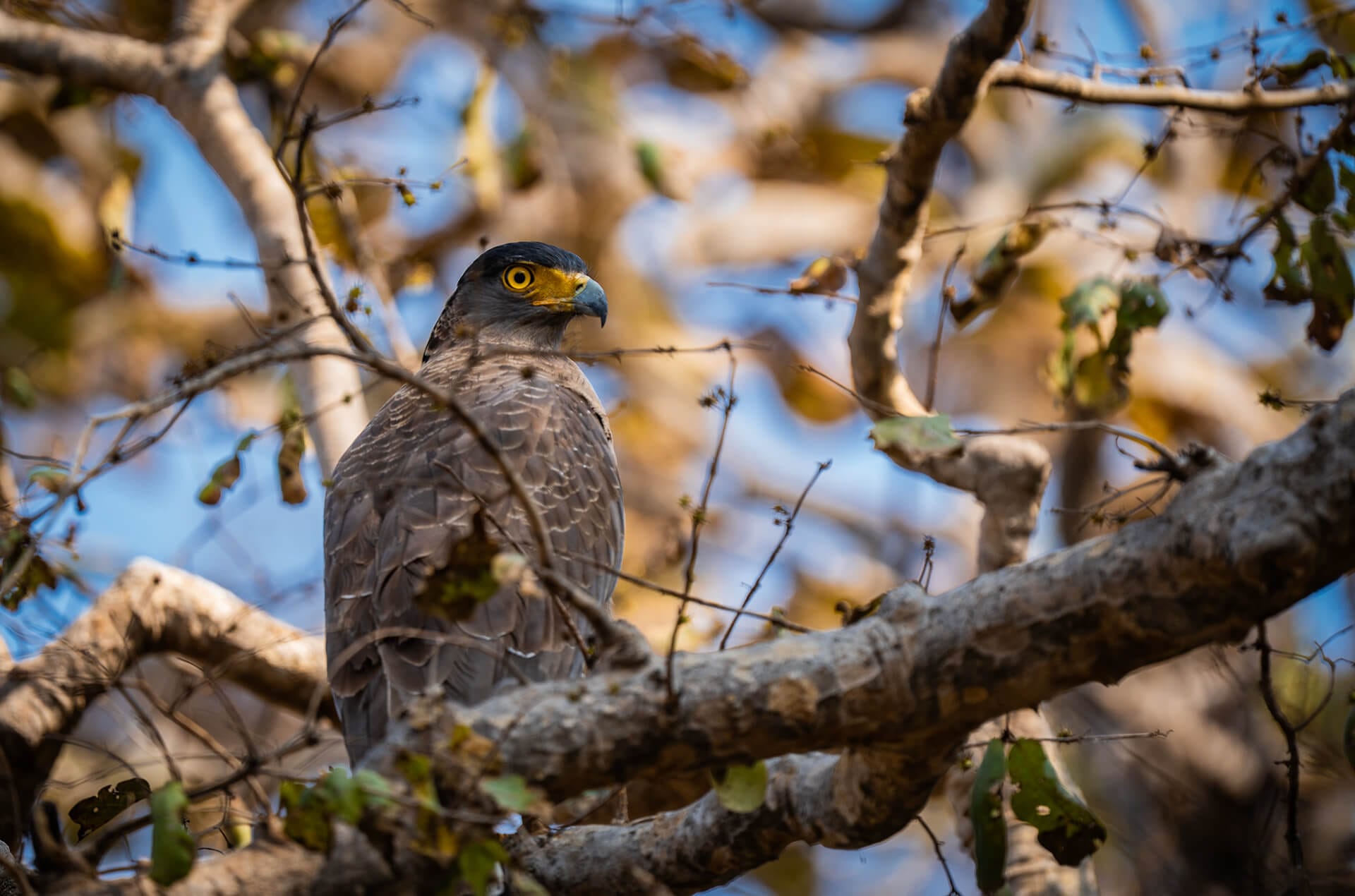
Panna's wildlife diversity is defined by three dimensions unavailable together at any other Central Indian reserve: a radio-monitored tiger recovery population, critically endangered gharial on the Ken River, and the finest vulture habitat in Central India.
Bengal Tiger
Panthera tigris tigris
Every tiger individually identified and actively radio-monitored. Expert guides can track current animal movement with remarkable accuracy — creating a quality of informed encounter unavailable elsewhere in India.
Gharial
Gavialis gangeticus
The most endangered crocodilian in the world. The Ken river provides some of the last viable gharial habitat in India. A sighting here is, for any guest who understands its context, more significant than the tiger.
Mugger Crocodile
Crocodylus palustris
Regularly observed during boat safaris along sandy riverbanks and sandstone gorges. The boat safari vantage point provides close-range encounters impossible from a jeep.
Indian Leopard
Panthera pardus fusca
Frequent sightings throughout Panna's rocky ridgelines and open dry forest terrain. Lower safari traffic and greater landscape visibility often provide exceptional photographic opportunities.
Sloth Bear
Melursus ursinus
Regular encounters in the dry teak landscape. Sightings become particularly rewarding during the Mahua flowering season in March and April when prolonged behavioural encounters are common.
Four-horned Antelope
Tetracerus quadricornis
One of the world's rarest antelope species. Panna's open scrub and mixed forest habitat supports a population that rewards patient guiding and elevates the experience for serious naturalists.
Chinkara
Gazella bennettii
Healthy populations in open scrub habitats across the reserve. The Indian gazelle adds a distinctive open-country dimension to Panna's wildlife list unavailable in the denser Central Indian reserves.
7 Vulture Species
Including Red-headed Vulture
Arguably the most important vulture habitat in Central India. Seven of India's nine vulture species nest along the dramatic Ken gorge cliffs — a globally significant concentration.
The reserve that requires two perspectives
Panna is the only major Central Indian tiger reserve where the safari programme fundamentally requires two modes of transport — jeep and boat. The Ken River adds a second ecological dimension entirely absent from Kanha, Bandhavgarh, or Pench.
Jeep Safari
Dry teak forest and tiger habitat
Jeep safaris through Panna's dry teak forest, Vindhyan sandstone plateaus, and seasonal grasslands access the reserve's growing Bengal tiger population, leopard habitat along rocky ridgelines, sloth bear territory, and the open scrub where chinkara and four-horned antelope are most reliably encountered. The radio-monitoring programme means guides have real-time intelligence on individual tiger locations.
Ken River Boat Safari
India's only river-based tiger reserve safari
Flat-bottomed boats operated along a section of the Ken river passing through gorge terrain, sandy beaches, and forest-edge habitat. The boats move silently with the current, approaching sandbanks at close range without vehicle noise. Produces four wildlife categories impossible from a jeep: gharial and mugger at close range on sandy beaches, water bird diversity, raptors working gorge updrafts, and the landscape itself in early light.
Ken Gharial Sanctuary
The world's most endangered crocodilian
Formally notified as part of the Panna Tiger Reserve's critical habitat, the Ken Gharial Sanctuary was established specifically to protect the gharial — a specialist found only in clean, fast-flowing rivers with sandy nesting beaches. The Ken holds one of the most reliably viewable gharial populations in India. Seeing one — a massive, distinctively long-snouted creature on a sandbank in morning light — is an encounter with a species that may not exist in the wild much longer outside a handful of protected rivers.
Khajuraho Cultural Circuit
Asia's finest medieval sculptural programme
Panna sits 25 kilometres from Khajuraho, the UNESCO World Heritage Site containing the most extraordinary collection of medieval temple sculpture in Asia. Built by the Chandela dynasty between 950 and 1050 CE, the Kandariya Mahadeva, Lakshmana, and Vishwanatha temples represent the pinnacle of Nagara architectural tradition. A serious guided visit with an art historian takes 3–4 hours and constitutes a genuinely significant cultural experience. The combination of tiger reserve and Khajuraho within a single itinerary is available nowhere else on earth.
Conservation history, river heritage, and Asia's finest temple sculpture
Panna delivers something no other destination in India can replicate — a UNESCO Biosphere Reserve with a tiger comeback story, a river safari with critically endangered gharial, and Asia's finest medieval sculptural programme, all within a 25-kilometre radius.
The Tiger Comeback Story
The gap between the official record and the reality of Panna's 2009 tiger collapse was exposed only when independent observers reported the absence of tigers. It forced a systemic reassessment of monitoring methodology across all of India's tiger reserves. Today, every tiger in Panna is descended from the reintroduced individuals — a second-generation recovery population whose existence is the direct result of deliberate, sustained human intervention in a conservation emergency.
Pandav Falls
Within the national park, a scenic waterfall associated with the Mahabharata tradition — the Pandavas are said to have halted here during their exile. The falls drop approximately 30 metres into a forested pool. In the post-monsoon months of October–November, the flow is at its most dramatic and the surrounding forest at its most atmospheric.
The Diamond Mines of Panna
The Panna region has been a source of diamonds for centuries — historically among the most significant diamond-producing areas in the world before the South African discoveries. The mines are geologically and historically interesting for any guest who wants to understand the full context of the Panna landscape and the deep human history of these Vindhyan hills.
The optimal window
The Ken River gives Panna a distinctive seasonal rhythm. The boat safari experience changes dramatically with water levels, making season selection here more nuanced than at purely land-based reserves.
Post-monsoon reopening. Forests lush, rivers full, waterfalls at their most dramatic, temperatures between 20–30°C. Particularly popular for landscape photography, boat safaris, birdwatching, and the Ken River at its most visually spectacular. Migratory birds begin arriving; Khajuraho is exceptionally photogenic in soft autumn light.
Panna's prime luxury safari season. Cool, comfortable temperatures (5–22°C), dry forest conditions, excellent wildlife visibility, and ideal conditions for tiger safaris, gharial sightings, birdwatching, and photography. As water levels recede, exposed sandbanks create outstanding opportunities to observe gharial basking in the winter sun. Early booking — 6–9 months — essential for the best availability.
Some of the best months for wildlife concentration and predator activity. Rising temperatures draw animals toward remaining water sources, improving tiger and leopard visibility across the dry teak landscape. Particularly rewarding for experienced wildlife photographers and boat safari specialists interested in crocodilian behaviour and dramatic riverine imagery.
Temperatures become extreme, often reaching 45°C, and safari operations gradually reduce before the annual closure. A niche choice for experienced travellers willing to work within challenging conditions to witness intense wildlife concentration near diminishing water sources.
The park closes during monsoon while the ecosystem regenerates naturally — rivers flood, waterfalls reach peak flow. Khajuraho continues to offer year-round cultural travel. The ideal planning window for securing lodge availability and permits for the season ahead.
We know Panna.
The question is when.
We do not run group itineraries to Panna. Every Safari Acacia visit is a bespoke programme combining jeep safari, Ken River boat safari, and where appropriate, the Khajuraho cultural circuit — designed as a complete experience.