Kanha
Where the Jungle Book Begins
The largest contiguous protected habitat in Central India. Not the densest tiger reserve — what Kanha offers is something a purely encounter-optimised safari cannot replicate: the complete ecological spectacle, including the barasingha found nowhere else on earth.
"The Central Indian sal forest that forms the structural imagination of the Jungle Books is not a literary invention. It is an ecological description. The open maidans, the bamboo breaks, the rocky hills — all of it is still here, in a condition of biological richness entirely recognisable today."
Open Window
The barasingha, the forest, and the greatest wildlife recovery in Asia
Kanha was first notified as a wildlife sanctuary in 1933 and established as a National Park in 1955. It was among the original nine tiger reserves designated under Project Tiger in 1974. The Kanha Tiger Reserve covers 1,945 square kilometres — a core zone of 940 square kilometres and a buffer of 3,500 square kilometres — making it one of the largest protected wildlife areas in India and the centrepiece of the Central Indian Tiger Landscape: the most significant contiguous tiger habitat corridor remaining on earth.
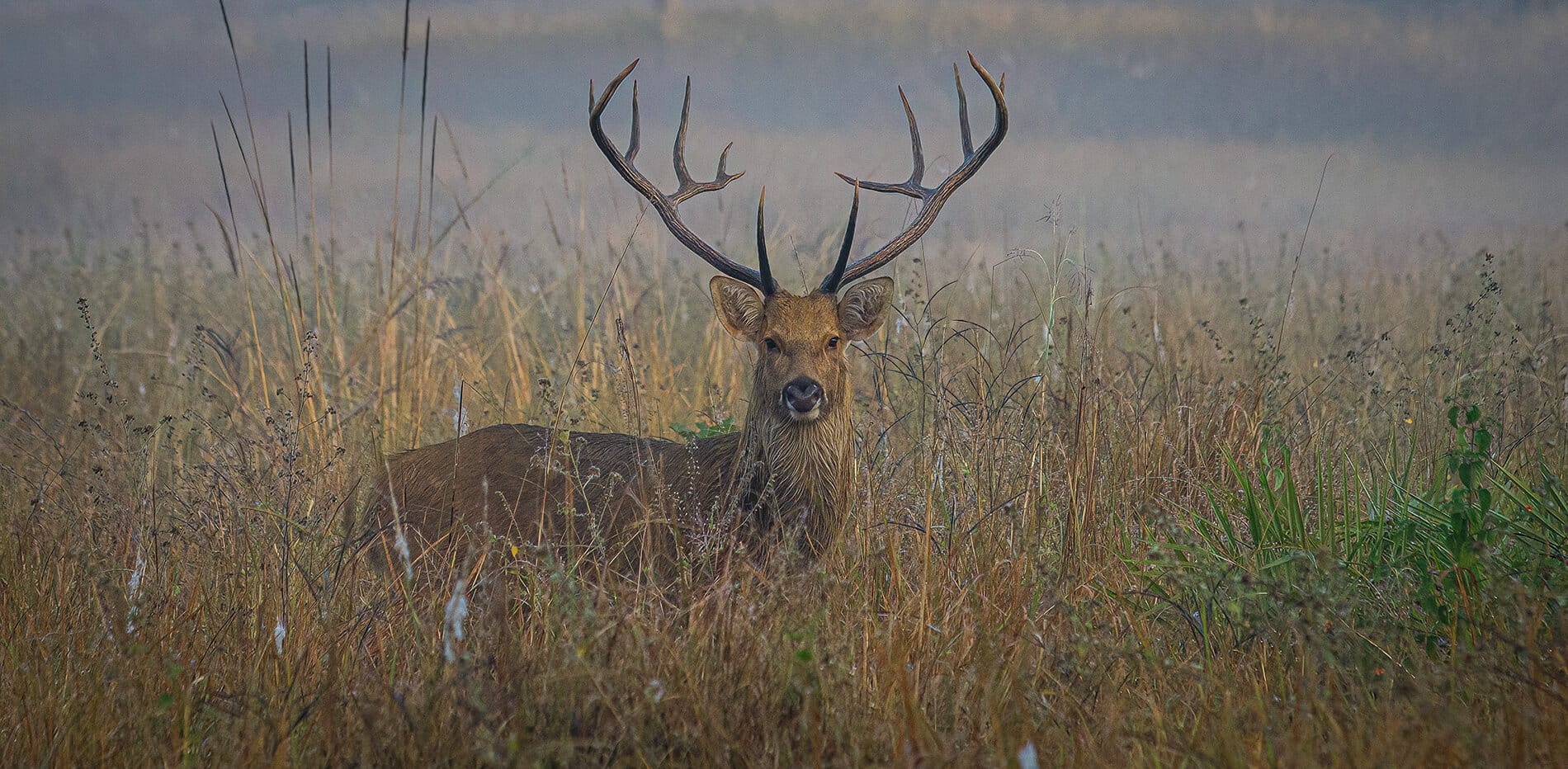
The park's history is inseparable from the story of the barasingha — the hard-ground swamp deer endemic to Central India. By the mid-1960s, the Kanha barasingha population had fallen to fewer than 70 individuals. The conservation programme launched in the 1970s reversed this trajectory entirely. The Kanha barasingha population today exceeds 600 individuals. It is one of the most complete wildlife recovery stories in Asia, and it is visible to every guest who spends a morning in the Kanha meadows.
Rudyard Kipling never visited Kanha — this tends to disappoint people until they spend a morning in the Kisli zone and understand precisely why it does not matter. The Central Indian sal forest that forms the structural imagination of the Jungle Books is not a literary invention. It is an ecological description. The open maidans where Mowgli ran with the wolf pack, the bamboo breaks where Baloo supervised his lessons — all of it is still here, in a condition of biological richness that is entirely recognisable today.
The Kisli maidans — Kanha's signature landscape, still functioning as Kipling described
"The barasingha is not a secondary attraction to the tiger. For the wildlife naturalist, it is an equal draw. For the conservation-aware traveller, it may be the primary one."
The Complete
Spectacle
Kanha is not India's most densely tiger-populated reserve — what it offers instead is the complete ecological experience: 22 mammal species, 325 bird species, and an ecosystem that demonstrates predator-prey interactions that most safari destinations can only gesture towards.
Bengal Tiger
Panthera tigris tigris
Over 150 tigers across the reserve. Kanha rewards with cinematic encounters — a tiger crossing a vast meadow in golden morning light is the park's signature sighting.
Barasingha
Rucervus duvaucelii branderi
The hard-ground swamp deer exists nowhere else on earth except Kanha. Recovered from 66 individuals in 1970 to over 600 today. One of conservation's most celebrated stories.
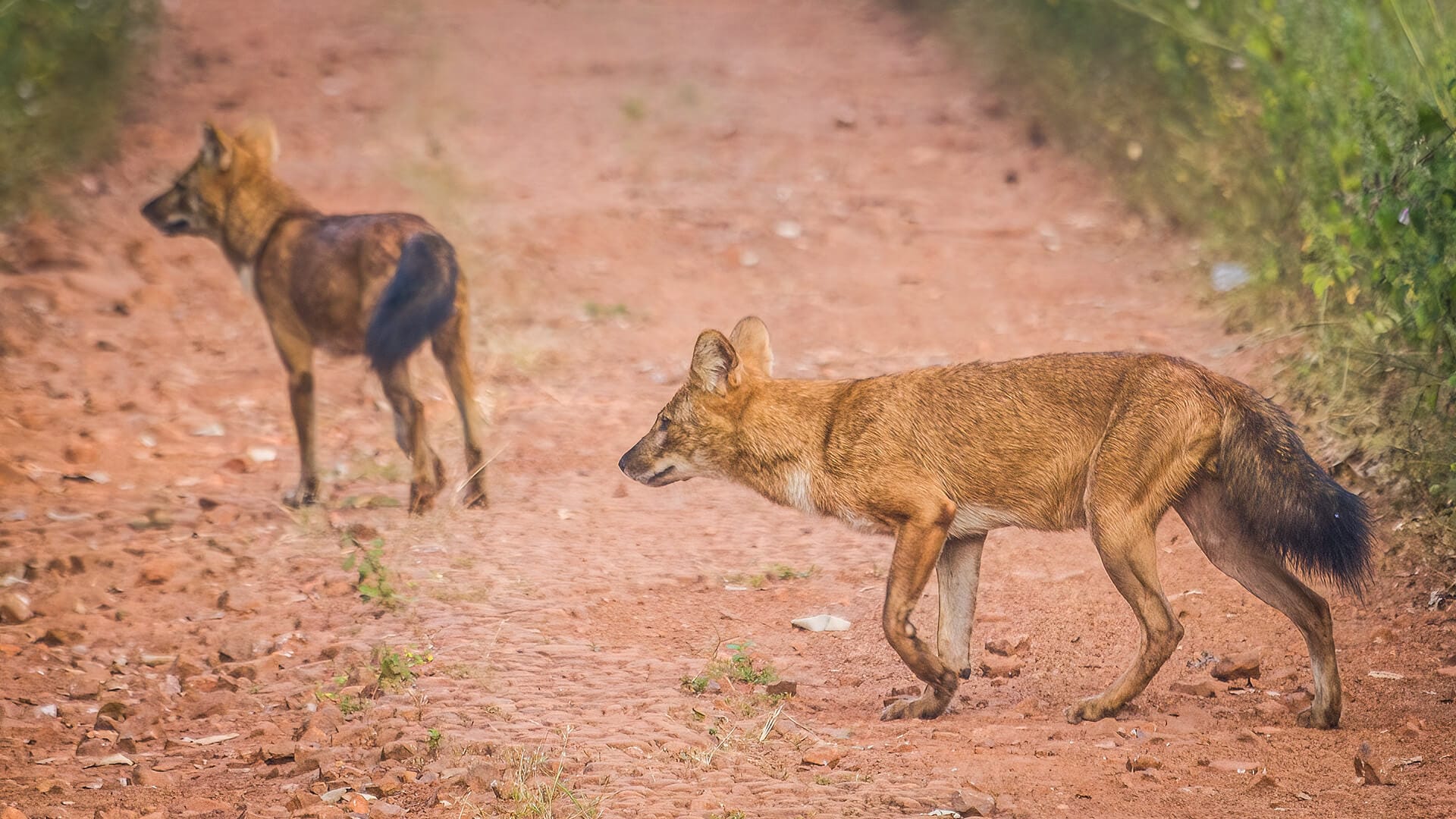
Dhole
Cuon alpinus
Pack dynamics deliver some of the most thrilling predator interactions in India. Mukki zone produces the most frequent encounters, especially during coordinated hunting sequences.
Indian Leopard
Panthera pardus fusca
Found in the rocky Mukki and Maikal zones. Lower safari traffic and greater visibility often provide exceptional photographic opportunities away from the tiger circuits.
Sloth Bear
Melursus ursinus
Seasonal highlights during the Mahua flowering months of March–April, when prolonged, behaviour-rich encounters are common near fruiting trees across the maidans.
Gaur
Bos gaurus
India's largest wild bovine, seen in large herds at dawn and dusk near Bamhni Dadar. Rare tiger–gaur interactions occasionally unfold near the plateau — among the most dramatic wildlife spectacles in India.
Jungle Cat
Felis chaus
Rewards attentive guiding and elevates the experience for seasoned naturalists. Among the specialist sightings that distinguish a knowledgeable guide from a route-follower.
325+ Bird Species
Including paradise flycatcher
Great slaty woodpecker, malabar pied hornbill, and the rare forest owlet recorded with regularity by specialist guides. Six kingfisher species on the rivers.
The most consequential planning decision
Kanha's four entry gates access distinct sections of the reserve with different tiger territory, habitat type, and wildlife character. Zone selection here, as at Bandhavgarh, is the decision that most generalist operators make without adequate knowledge of the distinctions.
Kisli Zone
Heartland of the Kanha experience
Accessed through Khatia village on the western edge, Kisli covers the great maidans of the Halon river valley. This is where Kanha's most habituated tigers hold their territories and where the barasingha herds are most reliably encountered. The maidan-centred safari experience — a tiger crossing open grass in good morning light — is most consistently available here. For any first-time Kanha visitor, Kisli is the correct entry point.
Kanha Zone
The Bamhni Dadar panorama
Overlaps with Kisli and extends eastward toward the Bamhni Dadar plateau — a raised grassland at approximately 900 metres offering one of the most visually commanding perspectives in Central Indian wildlife viewing. Gaur concentrations at dawn and dusk can be substantial. The plateau drive is a standard inclusion in any serious Kanha itinerary and should be timed for both sunrise and sunset.
Mukki Zone
Dhole and deep forest territory
Accessed from Mukki village on the southern boundary. The sal here is taller, the understorey richer, and the Banjar river provides permanent water through the dry season. Dhole pack encounters are more frequent in Mukki than in any other zone. The leopard habitat along the rocky Maikal section is excellent. For the experienced wildlife traveller for whom dhole and small cats are the primary draw, Mukki is the superior zone.
Sarhi Zone
The quiet northeast
Kanha's quietest and least visited core zone. The forest here transitions between core and buffer character, and wildlife behaviour reflects the lower human pressure — tigers maintain larger, less well-mapped territories and the drive experience is closer to genuine wilderness navigation than structured safari. For the traveller who wants the feeling of not knowing what will appear on the road rather than following a morning routine.
The literary forest, the recovered deer, the plateau at dawn
The depth of a Kanha visit comes from understanding what the forest represents — ecologically, historically, and in the literature that brought it to the world's attention.
The Jungle Book Connection
Kipling absorbed his material from colonial accounts, shikharis' tales, and the correspondence of forest officers who spent careers in this specific ecosystem. The Seoni district eastern part of Kanha is named in the Jungle Books as Mowgli's home territory. The ecology he describes — the wolf pack's territory, the tiger's ambush ground, the bear's forest forage — is the ecology of the Kanha maidans, still functioning, still visible on any well-guided drive.
The Barasingha Recovery
By 1970, fewer than 66 barasingha remained. Village relocation from the core zone, grassland restoration through controlled burning, and rigorous anti-poaching enforcement over two decades produced one of the most complete wildlife recoveries ever documented. The current population exceeds 600. The subspecies exists nowhere else on earth. Understanding this story is what distinguishes a visit to Kanha from a tiger encounter at any other reserve.
Bamhni Dadar at Dawn
The raised plateau in the Kanha zone at approximately 900 metres provides a rare top-down view of the forest canopy below. Gaur concentrations in the late afternoon can be substantial, and the occasional tiger–gaur interaction near the plateau edge is among the most dramatic wildlife spectacles the park offers. The drive to the plateau at first light — mist in the valleys below, the canopy still dark — is worth a specific session.
The optimal window
Each period delivers a distinct Kanha experience — distinct forest character, distinct wildlife behaviour, distinct light. Understanding the seasonal rhythm is what allows us to match the visitor to the right moment.
Post-monsoon revival. Lush green landscapes, cool temperatures (18–28°C), and a fresh cohort of migratory birds. Tiger territories are active and sightings begin early in the season, though taller grass in the maidans can slightly reduce visibility in the first weeks. The density, greenery, morning mist, and untouched wilderness create a rare photographic atmosphere that peak-season visitors often miss.
Widely regarded as the best time for a high-end wildlife safari at Kanha. Cool to cold temperatures (8–22°C), dry conditions, and fully open grasslands offer exceptional visibility across all zones. The optimal window for private tiger safaris, with increased encounter probability and perfect photography lighting. January and February combine crisp morning light, active dhole packs, and barasingha stags in full antler. Book 6–9 months in advance.
A completely different yet equally rewarding experience. Rising temperatures (25–38°C) and thinning vegetation intensify wildlife activity around water sources, improving sighting duration and quality. The Mahua flowering season attracts frequent, prolonged sloth bear encounters while sparse landscape enhances dramatic lighting for photography. One of the most compelling times for behavioural observation and ecological storytelling.
Intense heat (38–44°C) and gradual reduction in operational zones as the park approaches its June 30 closure. A deliberate niche choice for experienced safari enthusiasts targeting late May for extreme wildlife concentration near diminishing water sources. Not recommended for first-time visitors or those without tolerance for high heat.
Kanha closes for the monsoon as the ecosystem regenerates. The best availability for luxury safari lodges and premium permits for October and peak winter months is typically secured by April — the ideal planning window for the following season.
We know Kanha.
The question is when.
We do not run group itineraries to Kanha. Every Safari Acacia guest receives a bespoke programme — zone selection, private vehicle, expert naturalist guide — built around the specific wildlife experience they are seeking.