Deramakot Forest Reserve, Sabah
The Mammals of Deramakot
A working forest reborn as Borneo's most reliable wild cat country, and a stronghold for wild orangutan
Deramakot is not a typical stop on a Borneo itinerary. Tucked into the island's northeastern interior, it is a working forest reserve rather than a manicured tourist destination, and it draws a particular kind of traveller: the dedicated wildlife enthusiast, often chasing one animal above all others, the Sunda clouded leopard.
Considered a mammal paradise by naturalists and photographers who return year after year, Deramakot is one of the few places on earth where all five of Borneo's wild cat species share a single reserve. This guide covers what actually shares that forest with them, cats, primates, and the wider mammal checklist that keeps guests on their game drives until well after dark.
Dipterocarp Forest
Recorded Here
Orangutans
Logging Since
A Sanctuary for All Five Bornean Cat Species
Deramakot has long been considered one of the best places on earth to encounter every one of Borneo's wild cats, and regular photographic expeditions are built entirely around this reserve.
The largest carnivore on Borneo and the icon of Deramakot itself, once thought closer to myth than mammal. Sightings are rare, but genuinely more frequent here than almost anywhere else on the island, especially on night drives.
Seen on: Night DrivesThe most common cat species in Southeast Asia, and the only Bornean cat not currently considered threatened. Frequently spotted along roadsides while spotlighting, less often deeper in the forest.
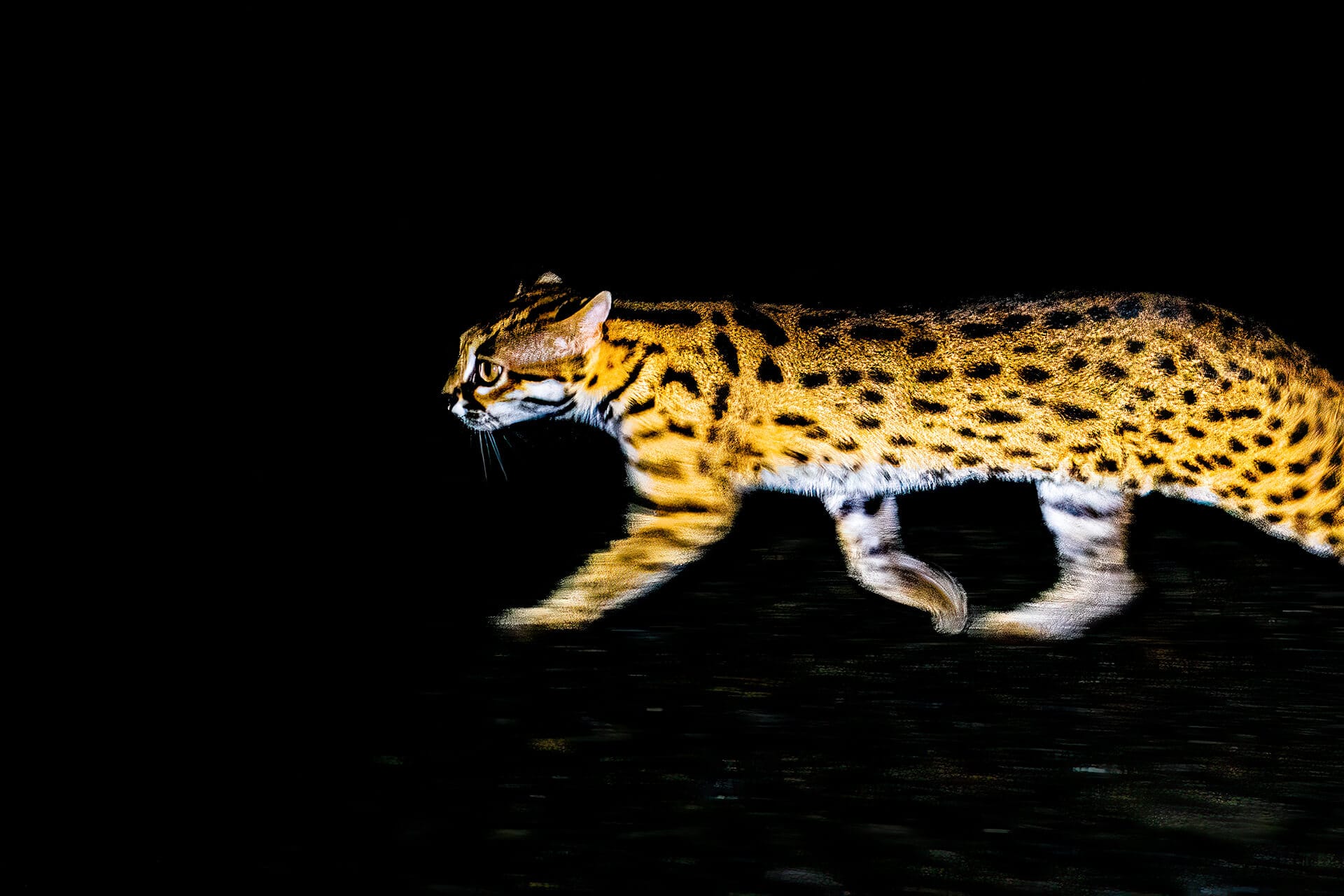
Seen on: Roadside SpotlightingA miniature echo of the clouded leopard, with a cloud patterned coat and an unusually long tail. Borneo's most arboreal cat, and a genuinely secretive one, so sightings stay occasional rather than reliable.
Seen on: Night Drives, OccasionalEndangered since 2008, and strongly tied to wetlands and waterways. Deramakot's own records confirm the pattern: every sighting here comes from the flatter, northwestern stretch of the reserve near its ponds and lakes.
Seen on: Wetland Areas, RareOne of the least documented cats anywhere, known mostly from incidental records across Sabah and Sarawak. It has been photographed inside Deramakot, one of the few reserves where that can be said with confidence.
Seen on: Rare, Camera Trap RecordsOrangutan, Gibbon and a Cast of Leaf Monkeys
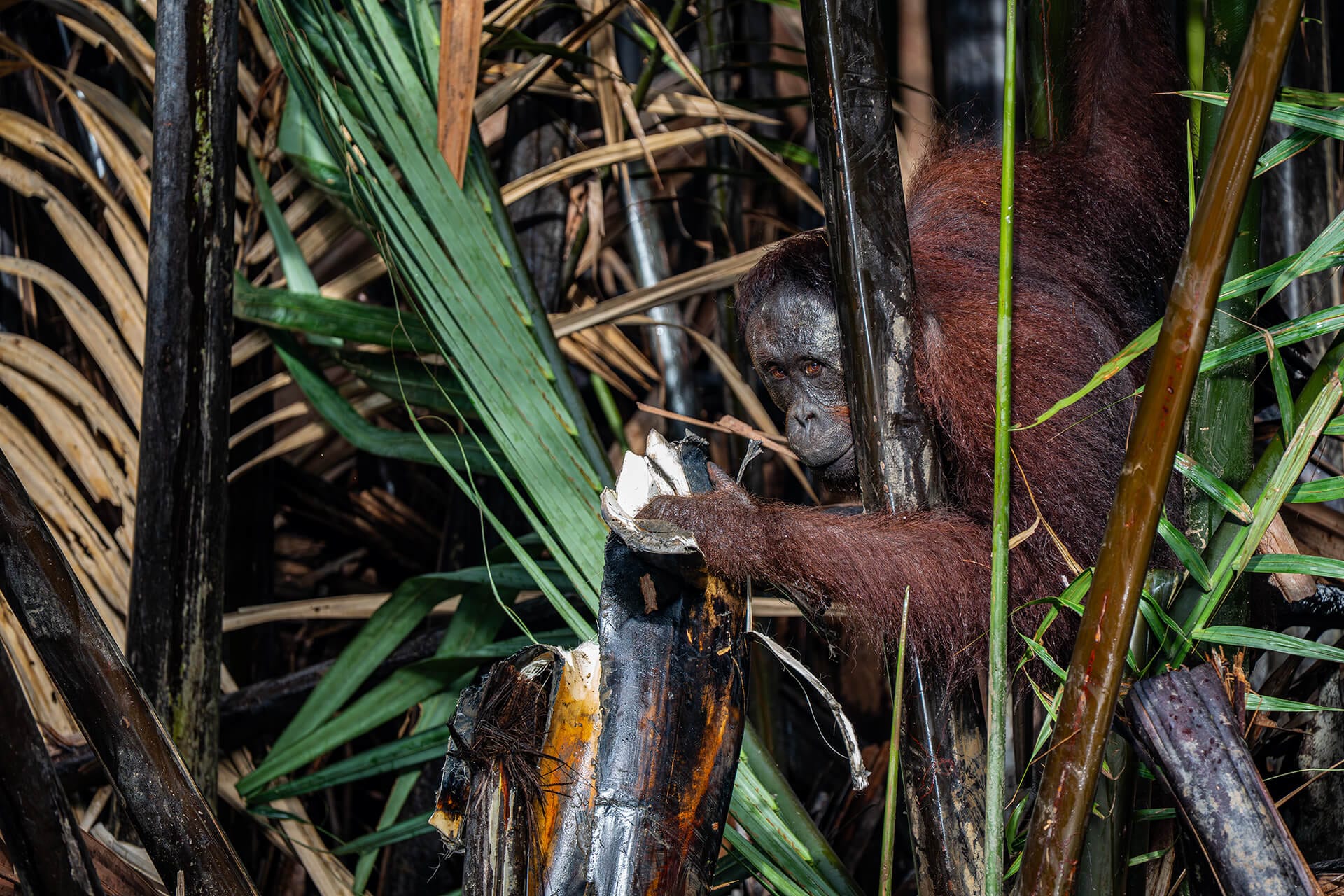
Deramakot holds a healthy, regularly sighted population of wild orangutan, alongside a genuinely diverse cast of smaller primates.
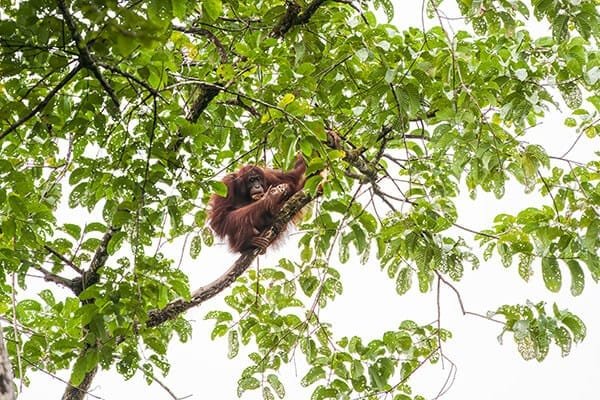
Deramakot holds a healthy, wild population of orangutan, regularly seen on morning game drives and, more rarely, glimpsed resting in a nest during the evening.
Seen on: Morning DrivesHeard well before it's seen, with loud calls carrying through the canopy each morning as small family groups swing actively from tree to tree.
Seen on: Morning DrivesThe most elusive primate on this list, and one of Borneo's least photographed. Our guests have been fortunate enough to see it on morning drives on several occasions.
Seen on: Morning Drives, RareA striking, rust coloured leaf monkey, generally curious yet shy around vehicles, and a regular feature of daytime sightings across the reserve.
Seen on: Day DrivesSilver grey troops travelling with strikingly orange coloured infants, seen along the forest edge and roadside clearings.
Seen on: Day DrivesA ground dwelling macaque encountered regularly across the reserve, usually in small, active troops moving along the forest floor.
Seen on: Day DrivesThe Rest of Deramakot's Mammal Checklist
A reserve this intact turns up an unusually long list of nocturnal specialists, night after night.
Borneo's other iconic large mammal, and a fairly regular sighting on Deramakot's game drives, usually moving through the forest in small family groups.
Seen on: Day & Night DrivesThe largest and most distinctive of Deramakot's civets, with a prehensile tail and a scent often described as fresh popcorn. A genuine highlight when it turns up on a night drive.
Seen on: Night Drives, OccasionalOne of the rarest and least known civets anywhere, so rare that many visitors don't realise it exists at all. Deramakot is one of the few reserves where it is recorded with any regularity.
Seen on: Night Drives, RareA tiny, entirely carnivorous nocturnal primate, tracked by torchlight for the telltale flash of its huge reflective eyes.
Seen on: Night DrivesThe largest deer species in the reserve, most often seen grazing along the forest roads in the cooler hours around dawn and dusk.
Seen on: Dawn & Dusk DrivesAlmost always seen in pairs, moving with the quick, confident energy typical of this small, highly active predator.
Seen on: Day DrivesLonger stays turn up a genuinely long tail of further species: mouse deer, Thomas's flying squirrel, red giant flying squirrel, slow loris, Sunda flying fox, and a remarkable range of smaller civets, including the island palm civet, Malay civet, small toothed palm civet and masked palm civet. Sightings vary with the season and the individual night, which is precisely what keeps experienced guests coming back.
The Birds Sharing the Same Forest
Deramakot is a mammal focused reserve first, but its birdlife rewards attention in its own right. All eight of Borneo's hornbill species are recorded here, rhinoceros, helmeted, wrinkled, white crowned, oriental pied, Asian black, bushy crested and wreathed. Crested serpent eagle, white fronted falconet, red bearded bee eater, and the endemic Bornean bristlehead all turn up on a typical game drive, alongside several species of flycatcher, barbet, bulbul and babbler. Guests with a serious interest in birding can find a detailed, regularly updated species list for the reserve on eBird.
A Restricted Forest: Only With the Right Guide
Deramakot is a working, protected reserve, not a jungle open to independent wandering.
Access is tightly controlled, and only guests travelling with an experienced, permitted guide are allowed inside. This exists to protect a genuinely delicate ecosystem, and it works in the visitor's favour too, since a senior guide here is as much storyteller as navigator, drawing on years, often decades, of experience reading this particular forest.
Many of Deramakot's guides grew up in the surrounding communities and have spent their working lives in these same trails. Their knowledge of the reserve's nocturnal rhythms, and of exactly where to point a spotlight at exactly the right moment, is the difference between a good game drive and a forgettable one.
Responsible Travel: Preserving Deramakot's Legacy
Deramakot is a genuine conservation success story. Through the 1990s it was transformed from a conventional logging concession into a sustainably managed forest reserve, with reduced impact logging practised since 1997 alongside a clear ecotourism and conservation mandate. Today it stands as an important sanctuary for endangered species, with visitor numbers carefully managed to prevent over tourism and keep the forest close to its natural condition.
Travelling here with a senior guide, following the reserve's entry and vehicle permit rules, and leaving no trace all directly support that ongoing conservation effort, and are simply the only way to visit Deramakot in the first place.
Questions we are asked first
Planning Your Visit
Why do I need to book a Deramakot trip early?
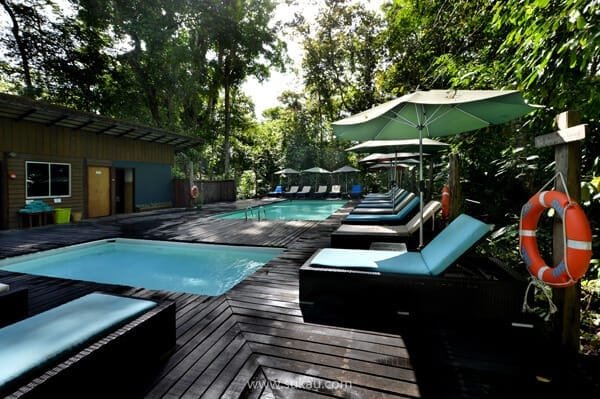
There is only one accommodation option inside the entire Deramakot Forest Reserve, and it runs fully booked for most of the year, often months or even years in advance. We also need to block our senior Deramakot specialist guides well ahead of your dates, so early booking genuinely matters here.
Can I visit Deramakot in the rainy season?
Borneo's rainforest is prone to sudden downpours year round. Pack proper waterproof gear, a jacket, footwear and a cover for your bag, and treat the occasional shower as part of the experience. The reserve's wildlife is generally more active with a little rain than in prolonged dry spells.
What should I bring when visiting Deramakot?
Lightweight, long sleeved clothing for insect protection, a rain jacket or poncho with cover for your camera gear, sturdy footwear for uneven trails, binoculars, insect repellent, sunscreen and a good flashlight for night safaris.
Which camera lens should I bring to Deramakot?
At least 300mm reach is recommended. A semi pro zoom in the 150 to 600mm or 200 to 600mm range, paired with a 70 to 200mm, covers most sightings well, and a 24 to 70mm is handy for landscapes. Most photography here happens in low light, so a body that handles high ISO cleanly matters as much as reach.
Is Deramakot safe for tourists?
Yes, Deramakot is generally considered safe. As with any wildlife destination, that comes with following your guide's safety guidance, respecting the wildlife, and being prepared for rough terrain and changeable weather.
In the Reserve
Why is a good guide so important in Deramakot?
Your senior guide is effectively your key to the forest. They carry a deep, often lifelong understanding of Deramakot's mammals, its nocturnal rhythms and its trails, and come equipped with proper spotlights and scopes, all of which shapes how much you actually see.
Can I visit Deramakot independently, or do I need a guide?
Walk in safaris aren't permitted inside Deramakot Forest Reserve. Entry and vehicle permits must be arranged in advance, and visiting with an experienced guide is highly recommended for both safety and sightings. We arrange the full booking, permits and accommodation directly.
What activities can I do in Deramakot?
Day and night game drives, and birdwatching, all guided. Most of a typical stay is built around dawn, dusk and night 4WD drives, since that's when the reserve's mammals are most active.
Can I see orangutans in Deramakot?
Yes. Bornean orangutans are regularly seen in Deramakot, especially on morning game drives, and the reserve holds a healthy, genuinely wild population. Unlike the feeding stations at rehabilitation centres such as Sepilok or Semenggoh, every sighting here is of a wild, unhabituated animal.
Is Deramakot suitable for birdwatching?
Absolutely. All eight Bornean hornbill species are recorded here, alongside sought after species like the endemic Bornean bristlehead, the white fronted falconet and the dusky broadbill.
Is Deramakot Forest Reserve affected by logging?
Deramakot is a sustainably managed forest reserve. Reduced impact logging does still take place, but it is carried out responsibly, with biodiversity as a stated priority, and the resulting regrowth and logging roads can even benefit certain species, though some forest specialists are more sensitive to the disturbance.
Safari Acacia runs private, senior guided safaris into Deramakot Forest Reserve throughout the year. Read our full Deramakot travel guide, compare it against Danum Valley, Kinabatangan and Tabin, or see why it's our top pick in the best places to see wild orangutan.